
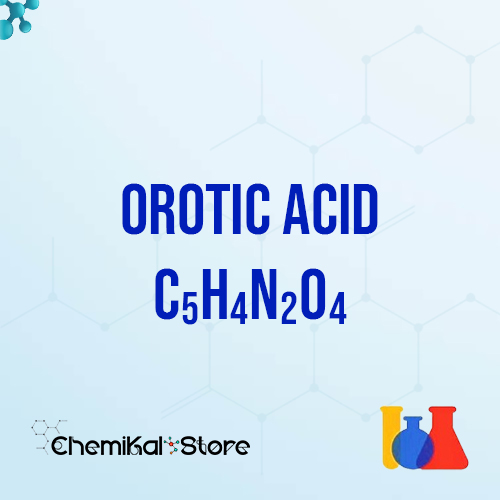


Orotic Acid
-
High-purity orotic acid for research, pharma, and nutrition
-
≥98% purity, COA, MSDS, and full batch traceability
-
Bulk and laboratory packaging, prompt India-wide delivery
-
Expert technical support from chemikalstore.com
- Estimated Delivery : Up to 8 business days
- Free Shipping & Returns : On all orders over ₹1000
Buy Orotic Acid Online – High-Purity Pyrimidine Intermediate for Research, Pharma, and Nutrition at chemikalstore.com
Orotic acid (CAS 65-86-1) is a high purity, heterocyclic, carboxylic acid, important in biochemistry, pharmaceutical research, food fortification and most analytic chemistry. Customers who purchase orally in chemikalstore.com secure a reagent- or pharmaceutical grade compound that is fully documented, batched, traced and delivered promptly all over India. The comprehensive manual includes technical characteristics, safety, use, and buying – optimized on all major keywords and oriented to laboratory, industry, and commercial purchasers.
What is Orotic Acid?
Orotic acid, also referred to as vitamin B 13, is a pyrimidinecarboxylic acid and a precursor in the synthesis of pyrimidine nucleotides (uracil, cytosine, and thymine). Intestinal flora produces it in the body and it also occurs in dairy products and in some plants. The compound has many applications in research, pharmaceuticals, and the nutrition of animals and as a carrier of minerals in dietary supplements.
Synonyms and Identifiers
-
Orotic acid
-
2,6-Dioxo-1,2,3,6-tetrahydropyrimidine-4-carboxylic acid
-
Uracil-6-carboxylic acid
-
Whey factor, Oropur, Orotyl, Orodin
-
CAS Number: 65-86-1 (anhydrous), 50887-69-9 (monohydrate)
-
EC Number: 200-619-8
-
Molecular Formula: C₅H₄N₂O₄ (anhydrous), C₅H₆N₂O₅ (monohydrate)
-
Molecular Weight: 156.1 g/mol (anhydrous), 174.11 g/mol (monohydrate)
-
PubChem CID: 967
Key Chemical and Physical Properties
| Property | Specification |
|---|---|
| Appearance | White to off-white crystalline powder |
| Purity | ≥98% (HPLC/GC) |
| Melting Point | >300°C (decomposes) |
| Solubility | Slightly soluble in water (1.7 mg/mL), DMSO, ammonium hydroxide; insoluble in chloroform |
| pH (1% solution) | Slightly acidic |
| Storage Temp | Room temperature, sealed, dry |
| Packaging | 25g, 100g, 500g, 1kg bottles; custom bulk |
| Documentation | COA, MSDS, HPLC/GC reports |
Biological and Biochemical Role
-
Pyrimidine Biosynthesis: Orotic acid is directly converted into uridine monophosphate (UMP) as a pyrimidine-de novo compound. It is converted to orotidine-5-monophosphate (OMP) using the phosphoribosyltransferase (OPRT) followed by decarboxylated to UMP, a RNA and DNA polymer.
-
Metabolic Pathways: Orotic acid plays a role in the metabolism of folic acid and vitamin B12 and its overabundance is able to spare or partially compensate for deficits in vitamin B12.
-
Mineral Carrier: Lithium, magnesium and zinc are some of the minerals that are produced through the formation of salts with orotates in the dietary supplements to enhance their availability.
Applications of Orotic Acid
1. Pharmaceutical and Biochemical Research
-
Nucleotide Synthesis: Applications in the pyrimidine biosynthesis, enzyme kinetics (OPRT), and metabolic regulation.
-
Drug Discovery: Starting material of uridine, cytidine and analog; Intermediate in production of antiviral and anticancer agent.
-
Disease Research: Based on modeling of orotic aciduria, a rare genetic disorder, and urea cycle defects and hepatic metabolism.
2. Food and Nutrition
-
Vitamin B13 Source: Orally administered acid is historically referred to as vitamin B13, is used as an ingredient in food fortification, and as a nutritional supplement.
-
Mineral Orotates: Mineral dietary supplement carrier (e.g., lithium orotate, magnesium orotate), which is said to improve absorption and bioavailability.
3. Animal Feed and Veterinary Use
-
Growth Promoter: This is an animal feed additive that helps to aid in the growth, reproduction, and metabolism of animals, primarily livestock and poultry.
-
Dairy Science: Ororal acid is found in whey and milk and is used as a metabolic health indicator with the dairy cows
4. Analytical Chemistry
-
Reference Standard: (HPLC) The standard is used in enzymatic assays, HPLC and GC to determine the pyrimidines and other metabolites.
-
Biomarker: Measurement of the levels of orotic acid in urine is used to diagnose the disorders of the urea cycle and some metabolic diseases.
5. Cosmetics and Bodybuilding
-
Cosmetic Ingredient: Used for its antioxidant and skin-conditioning properties in some formulations.
-
Sports Nutrition: Marketed as a supplement to enhance ATP production and endurance, though clinical evidence is limited
Technical Specifications and Quality Control
| Parameter | Specification | Test Method |
|---|---|---|
| Purity | ≥98% | HPLC, GC |
| Water Content | ≤0.5% | Karl Fischer |
| Residual Solvents | ≤0.5% | GC-HS |
| Appearance | White/off-white solid | Visual |
| Melting Point | >300°C (decomposes) | Capillary method |
| Solubility | Water, DMSO, NH₄OH | Visual |
| Identity (NMR/IR) | Conforms | ¹H/¹³C NMR, FTIR |
| Heavy Metals | ≤10 ppm | ICP-OES |
Safety, Handling, and Storage
Hazard Classification (GHS/CLP)
-
H302: Harmful if swallowed
-
H315: Causes skin irritation
-
H319: Causes serious eye irritation
-
H335: May cause respiratory irritation
-
NFPA/HMIS Ratings: Health = 2, Fire = 0, Reactivity = 07
Precautions
-
Use gloves, goggles, and lab coat.
-
Avoid inhalation, ingestion, and skin/eye contact.
-
Handle in a fume hood if dust is generated.
First Aid
-
Skin/Eye Contact: Rinse with water for 15 minutes, seek medical attention if irritation persists.
-
Inhalation: Move to fresh air, seek help if symptoms persist.
-
Ingestion: Rinse mouth, do not induce vomiting, get medical help.
Storage and Disposal
-
Store tightly sealed, in a dry, cool place at room temperature
-
Dispose of waste according to local hazardous waste regulations.
Comparison: Orotic Acid vs. Orotic Acid Monohydrate
| Parameter | Orotic Acid (Anhydrous) | Orotic Acid Monohydrate |
|---|---|---|
| CAS Number | 65-86-1 | 50887-69-9 |
| Molecular Formula | C₅H₄N₂O₄ | C₅H₆N₂O₅ |
| Molecular Weight | 156.1 g/mol | 174.11 g/mol |
| Appearance | White powder | White/off-white powder |
| Solubility (Water) | Slightly soluble | Slightly soluble |
| Melting Point | >300°C | >300°C |
| Use | Research, pharma, nutrition | Research, food, nutrition |
How to Buy Orotic Acid Online at chemikalstore.com
-
Visit chemikalstore.com and search for “orotic acid online”.
-
Review product details: Purity, batch size, documentation, and price.
-
Order or enquire online: Use enquiry form in order to apply custom or bulk prices.
-
Safety checkout: Various methods of payment, GST invoicing, and tracking shipments.
-
Receive COA and MSDS: With every batch for regulatory compliance and quality assurance.
Packaging and Supply Options
| Package Size | Application | Typical Users |
|---|---|---|
| 25g, 100g | Laboratory research | Academic, R&D labs |
| 500g, 1kg | Synthesis, pilot scale | Pharma, biotech |
| 5kg, 25kg+ | Bulk, industrial | Manufacturers, CROs |
All shipments include COA, MSDS, and batch traceability. Custom and bulk packaging available.
Frequently Asked Questions (FAQ)
Q1: Is orotic acid a vitamin?
A: It used to be denoted as vitamin B13 but today it belongs to the group of non-vitamin pyrimidinecarboxylic acid.
Q2: What is the main use in biochemistry?
A: It is a key intermediate in the biosynthesis of pyrimidine nucleotides (UMP, CMP, TMP)
Q3: Is it safe for human consumption?
A: Research and analytical grades are not for direct human use. Food-grade orotic acid is used in supplements, but only as permitted by regulations
Q4: What is orotic aciduria?
A: This is a rare genetic disease that leads to excess orotic acid in the urine, which is associated with the defects of the urea cycle and the disorders of the pyrimidine metabolism.
Q5: Does orotic acid enhance mineral absorption?
A: Orotic acid forms orotates (e.g., magnesium orotate) that are claimed to improve mineral bioavailability
Q6: What documentation is provided?
A: A batch is accompanied with a COA, MSDS, and analytical (HPLC, NMR) data, used to be able to check their quality and regulatory purposes.
Summary Table: Orotic Acid
| Parameter | Value |
|---|---|
| CAS Number | 65-86-1 (anhydrous), 50887-69-9 (monohydrate) |
| Synonyms | Vitamin B13, uracil-6-carboxylic acid |
| Molecular Formula | C₅H₄N₂O₄ (anhydrous) |
| Molecular Weight | 156.1 g/mol (anhydrous) |
| Appearance | White to off-white powder |
| Purity | ≥98% (HPLC/GC) |
| Melting Point | >300°C (decomposes) |
| Solubility | Slightly soluble in water, DMSO |
| Packaging | 25g–25kg bottles, bulk on request |
| Documentation | COA, MSDS, HPLC/GC |
| Supplier | chemikalstore.com (India) |
Reviews
There are no reviews yet.