
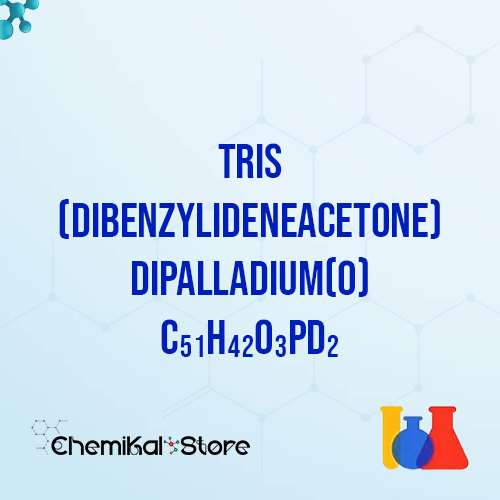



Tris(dibenzylideneacetone)dipalladium(0)
-
High-purity Pd(0) catalyst for advanced cross-coupling and synthesis
-
≥98% purity, COA, MSDS, and full batch traceability
-
Bulk and laboratory packaging, prompt India-wide delivery
-
Expert technical support from chemikalstore.com
- Estimated Delivery : Up to 8 business days
- Free Shipping & Returns : On all orders over ₹1000
Buy Trisdibenzylideneacetonedipalladium0 (Tris(dibenzylideneacetone)dipalladium(0) Online – High-Purity Pd(0) Catalyst for Advanced Synthesis at chemikalstore.com
Trisdibenzylideneacetonedipalladium0 (Tris(dibenzylideneacetone)dipalladium(0), which is also abbreviated as Pd₂(dba)₃ or tris-DBA, is the contemporary gold-standard source of soluble palladium(0) used in organic synthesis, catalysis, and in materials science. Your purchase of tris(dibenzylideneacetone)dipalladium(0)dipalladium(0) at chemikalstore.com comes with a research grade, high-purity catalyst with complete documentation, batch trace, and timely delivery all over India. This technical manual includes technical properties, applications, safety, and purchasing- optimized to all key terms, and adjusted to laboratory, industrial, and commercial customers.
What is Tris(dibenzylideneacetone)dipalladium(0)?
Tris(dibenzylideneacetone)dipalladium( 0 ) is a dark-purple to brown powder, soluble moderately in organic solvents, and powerful as a precursor of Pd(0) catalysts of many reactions. Its equation is [Pd₂(dba)₃], and dba is the acronym of dibenzylideneacetone. The complex is an assembly that is trimeric, two centers of palladium(0) are bridged by three dba ligands.
Synonyms and Identifiers
-
Tris(dibenzylideneacetone)dipalladium(0)
-
Pd₂(dba)₃
-
Tris-DBA
-
CAS Number: 51364-51-3
-
Molecular Formula: C₅₁H₄₂O₃Pd₂
-
Molecular Weight: 915.7 g/mol
Key Chemical and Physical Properties
| Property | Specification |
|---|---|
| Appearance | Dark purple to brown powder/crystals |
| Purity | ≥98% (HPLC/ICP) |
| Palladium Content | 21.5–25% (by weight) |
| Melting Point | 152–155°C (decomposes) |
| Solubility | Modestly soluble in DCM, toluene, THF, benzene, chloroform; insoluble in water |
| Storage Temperature | 2–8°C, dry, dark, under inert gas |
| Packaging | 100 mg, 500 mg, 1 g, 5 g, 10 g, custom bulk |
| Documentation | COA, MSDS, HPLC/ICP/OES reports |
Structure and Reactivity
-
Trimeric Structure: Pd(0) atoms are coordinated to the alkene moieties of 3 dba ligands with the two Pd atoms being separated by approximately ~320 pm.
-
Ligand Lability: The dba ligands readily dissociate to allow in-situ production of highly reactive Pd(0) catalyst.
-
Solubility: A variety of organic solvents are soluble which allows homogeneous catalysis.
Catalytic and Synthetic Applications
1. Cross-Coupling Reactions
Pd₂(dba)₃ is the catalyst of choice for a wide array of C–C and C–N bond-forming reactions:
-
Suzuki–Miyaura Coupling: Aryl halides + boronic acids → biaryls
-
Heck Reaction: Aryl halides + alkenes → substituted alkenes
-
Negishi Coupling: Aryl halides + organozincs → biaryls/alkenes
-
Stille Coupling: Aryl halides + organostannanes → biaryls
-
Buchwald–Hartwig Amination: Aryl halides + amines → arylamines
-
Kumada Coupling: Aryl halides + Grignard reagents → biaryls
-
Sonogashira Coupling: Aryl halides + alkynes → arylalkynes
2. Advanced Synthesis and Method Development
-
Asymmetric Catalysis: A asymmetric catalysis is utilized with chiral ligands (e.g., BINAP) in performing an enantioselective transformation.
-
Direct Arylation: Site-selective C -H activation of streamlined synthesis.
-
One-Pot Multistep Synthesis: Palliative Can be used in tandem and cascade reactions to assemble complex molecules.
-
Epoxide and Indoline Synthesis: The Majority in heterocyclic and natural product scaffolds.
3. Materials Science and Nanotechnology
-
Semiconductor Polymers: Semiconductor Polymers are used in the process of making high performance thin-film transistors.
-
Palladium Nanoparticles: Precursor for nanocatalysts in hydrogenation and electrocatalysis.
-
Liquid Crystal Synthesis: The major process in the production of state-of-the-art display materials.
4. Pharmaceutical and Fine Chemical Manufacturing
-
API Synthesis: Critical for C–C and C–N couplings in drug development and scale-up.
-
Agrochemicals: Synthesis of pesticides, herbicides, and fungicides
-
Custom Ligand Complexes: Precursor for the preparation of a wide range of functionalized Pd(0) complexes.
Technical Specifications and Quality Control
| Parameter | Specification | Test Method |
|---|---|---|
| Purity | ≥98% | HPLC, ICP-OES |
| Palladium Content | 21.5–25% | ICP-OES |
| Water Content | ≤0.5% | Karl Fischer |
| Residual Solvents | ≤0.5% | GC-HS |
| Appearance | Dark purple/brown | Visual |
| Melting Point | 152–155°C | Capillary method |
| Solubility | DCM, toluene, THF | Visual |
| Identity (NMR/IR) | Conforms | ¹H/¹³C NMR, FTIR |
Safety, Handling, and Storage
Hazard Classification (GHS/CLP)
-
Toxic if swallowed
-
Very toxic in contact with skin
-
Irritating to eyes, respiratory system, and skin
-
Very toxic to aquatic life with long-lasting effects
Precautions
-
Use gloves, goggles, and lab coat.
-
Handle in a fume hood or glovebox.
-
Avoid inhalation, ingestion, and skin/eye contact.
-
Prevent environmental release.
First Aid
-
Skin/Eye Contact: Rinse with water for 15 minutes, seek medical attention.
-
Inhalation: Move to fresh air, seek help if symptoms persist.
-
Ingestion: Rinse mouth, do not induce vomiting, get medical help.
Storage and Disposal
-
Store tightly sealed, under inert gas, in a cool, dry, dark place (2–8°C).
-
Dispose of waste according to local hazardous waste regulations.
Comparison: Pd₂(dba)₃ vs. Other Palladium Catalysts
| Catalyst | Activity | Initiation | Functional Group Tolerance | Air/Water Stability | Typical Use |
|---|---|---|---|---|---|
| Pd₂(dba)₃ (this product) | Very High | Fast | Excellent | Moderate | Cross-coupling, R&D |
| Pd(PPh₃)₄ | High | Fast | Good | Moderate | Suzuki, Stille, Heck |
| PdCl₂(dppf) | High | Moderate | Good | Good | Buchwald–Hartwig, Suzuki |
| Pd(OAc)₂ | Moderate | Slow | Moderate | Good | General catalyst |
| Pd/C | Moderate | Slow | Limited | Good | Hydrogenation, reduction |
How to Buy Tris(dibenzylideneacetone)dipalladium(0) Online at chemikalstore.com
-
Enter into chemikalstore.com and CTLD: tris(dibenzylideneacetone)dipalladium(0).
-
Use of review product information: Purity, batch, documentation, and price.
-
Request or place an order online: Request a custom or bulk price with the help of the enquiry form.
-
Safe checkout with various payment methods, GST invoicing and shipment tracking.
-
Get COA and MSDS with each batch as a compliance and quality control measure by the regulations.
Packaging and Supply Options
| Package Size | Application | Typical Users |
|---|---|---|
| 100 mg, 500 mg | Laboratory research | Academic, R&D labs |
| 1 g, 5 g, 10 g | Synthesis, pilot scale | Pharma, chemical R&D |
| 50 g, 100 g+ | Bulk, industrial | Manufacturers, CROs |
All shipments include COA, MSDS, and batch traceability. Custom and bulk packaging available.
Frequently Asked Questions (FAQ)
Q1: What is the shelf life of tris(dibenzylideneacetone)dipalladium(0)?
A: 12–24 months when stored under inert gas at 2–8°C, protected from light and moisture.
Q2: Is it suitable for pharmaceutical manufacturing?
A: Yes, it is a commonly applied material to the production of APIs, fine chemicals and high-technology materials.
Q3: What solvents is it soluble in?
A: DCM, toluene, THF, benzene, and chloroform; insoluble in water.
Q4: Can it be used for Suzuki, Heck, and Buchwald–Hartwig reactions?
A: Yes, it is the preferred Pd(0) precursor on these and many other cross-coupling reactions.
Q5: What documentation is provided?
A: With every shipment, there are COA, MSDS and data analysis (HPLC, ICP-OES) that is required to assure regulatory and quality control.
Q6: Is it available for export?
A: Yes, chemikalstore.com has shipping across the borders and serves all the papers needed.
Summary Table: Tris(dibenzylideneacetone)dipalladium(0)
| Parameter | Value |
|---|---|
| CAS Number | 51364-51-3 |
| Synonyms | Pd₂(dba)₃, Tris-DBA |
| Molecular Formula | C₅₁H₄₂O₃Pd₂ |
| Molecular Weight | 915.7 g/mol |
| Appearance | Dark purple to brown powder |
| Purity | ≥98% (HPLC/ICP) |
| Melting Point | 152–155°C (decomposes) |
| Solubility | DCM, toluene, THF, benzene, chloroform |
| Packaging | 100 mg–100 g bottles, bulk on request |
| Documentation | COA, MSDS, HPLC/ICP-OES |
| Supplier | chemikalstore.com (India) |

Reviews
There are no reviews yet.